Hot dog buns wholesale: sizes, weights and how to calculate quantities needed
Sizes, weights, mini buns for catering, pre-sliced options and packaging: how to choose the right hot dog bun and calculate quantities for an event.
Buying hot dog buns wholesale isn't just about negotiating a better price per unit. It means choosing a size that suits the frankfurters and sausages on your menu, that works well in the kitchen and in storage, and that arrives in quantities matched to your venue's pace of service. This guide sums up the main variables, length, bun weight, cut and packaging, and offers a worked example for calculating quantities needed for an event.
Length: the bun follows the sausage
The first criterion is the proportion between bun and filling. A bun that's much shorter than the frankfurter leaves the ends exposed; one that's much longer leaves mouthfuls of plain bread. The figures below are commonly used indicative ranges, useful as a starting point: actual measurements depend on the manufacturer and should be checked in the technical data sheet.
| Size | Indicative bun length | Typical use |
|---|---|---|
| Mini/cocktail | approx. 8–12 cm | catering, canapé service, children's menus |
| Standard | approx. 15–18 cm | classic frankfurters, quick service |
| Long | approx. 19–24 cm | long sausages, "XL" hot dogs |
| Extra-long | over approx. 25 cm | special offerings, oversized sausages |
Beyond length, the cross-section matters too: a thin frankfurter in a very wide bun will rattle around, while a thick sausage in a narrow bun will split it. Before ordering large quantities, it's worth testing the bun with the actual sausage used, measured after cooking, since some sausages change size on the griddle or in water.
Bun weight
Indicative ranges apply to weight too: standard hot dog buns are often found, depending on recipe and length, in a range of about 40 to 70 grams; minis are generally under 35 grams; long formats can exceed this range. The actual weight is the one stated in the technical data sheet.
Bun weight affects three aspects:
- food cost: at the same price per kilo, a heavier bun costs more per portion;
- perceived satiety and menu pricing: a more generous bun supports a higher price point;
- bite balance: too much bread relative to the filling makes the product heavy.
Mini hot dog buns for catering
In catering and canapé service, the mini hot dog is a practical option: it's eaten in two or three bites, works well on a buffet and allows for more filling variations. For these formats, what matters most is consistency (pieces need to line up neatly on trays) and holding at room temperature, since several minutes often pass between preparation and consumption. Minis require more labour per portion served, which is worth factoring into the costing.
Pre-sliced or whole
Pre-sliced buns save a step and give a uniform cut: it's the most common choice in quick service. Check that the cut is the right depth and that the two halves don't separate. Whole buns offer more flexibility: you can choose between a side cut, a top cut, or piercing the bun for Nordic-style hot dogs, and the crumb stays protected for longer. However, this requires time and a knife or dedicated equipment.
Packaging and logistics
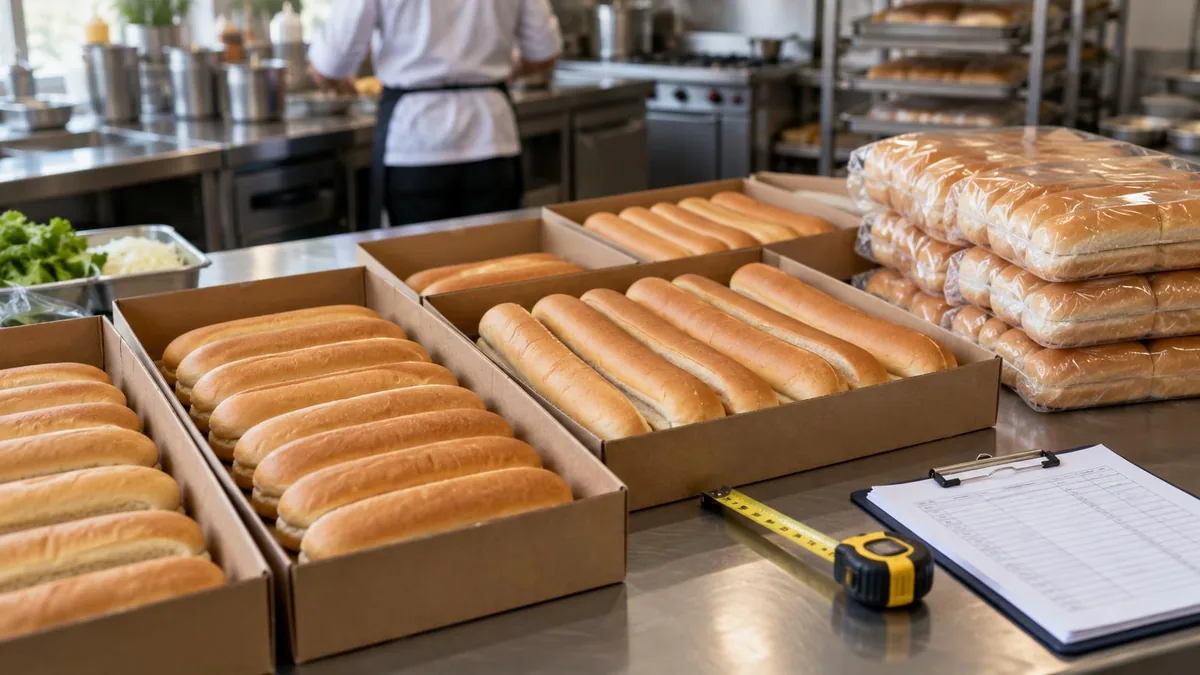
Packaging format affects storage, stock rotation and waste. Points to clarify with your supplier include:
- pieces per inner pack (bag or tray): smaller packs are opened and used up quickly, reducing waste;
- packs per carton and cartons per pallet, to organise deliveries and cold room space;
- freezer footprint for frozen product;
- minimum order quantity and lead times;
- labelling on each pack showing batch, shelf life and allergens, useful for traceability.
The number of pieces per carton varies from manufacturer to manufacturer: there's no standard, which is why quantity calculations should always be based on your own supplier's figures.
Worked example: calculating quantities for an event
The example below is purely illustrative: the figures are assumptions chosen to demonstrate the method, not reference data.
Assumptions:
- a 2-day event, with the outlet open 8 hours a day;
- service capacity estimated by the operator: 60 hot dogs an hour at peak times, 25 at other times;
- expected peak hours: 3 a day;
- safety margin chosen: 10%;
- supplier packaging: cartons of 48 buns (hypothetical figure).
Calculation:
- Peak hours: 3 × 60 = 180 hot dogs a day.
- Other hours: 5 × 25 = 125 hot dogs a day.
- Daily total: 180 + 125 = 305 hot dogs.
- Event total: 305 × 2 = 610 hot dogs.
- 10% margin: 610 × 1.10 = 671 buns.
- Cartons needed: 671 ÷ 48 = 13.98, i.e. 14 cartons (672 buns).
At this point, two more aspects need checking: the freezer space available on site for 14 cartons, and the thawing plan, which is best done in stages throughout the day to avoid having excess thawed bread left over at the end of service. If the menu also includes variants with a different bun, for example a gluten-free bun, the calculation should be repeated for each item, estimating the expected share of sales.
Organising wholesale purchasing
A few common-sense rules:
- Reduce the number of SKUs: every extra format complicates storage and stock rotation.
- Keep a sales history by event and by season, so estimates improve over time.
- Agree supplies in advance for peak periods.
- Check incoming goods: carton integrity, temperature for frozen product, match with the order.
- Evaluate the cost per portion served, including waste and unsold stock.
Frequently asked questions
How do I choose the right length for a hot dog bun?
Start with the length of the frankfurter or sausage after cooking: the bun should be roughly the same length or slightly shorter. Commonly used ranges are just a starting point; it's worth testing with the actual meat used on your menu.
Is it worth buying pre-sliced buns?
In quick service, usually yes, because it removes a step and gives a uniform cut. Whole buns are preferable when you want a particular cut, such as a top cut, or a pierced Nordic-style bun.
How many buns should I order for an event?
Estimate the number of portions based on service capacity and duration, add a safety margin, and round up to the number of cartons offered by your supplier. Sales history from similar events is the most reliable data for refining the estimate.