Hot dog buns: frequently asked questions from restaurant operators
Storage, reheating, steam or griddle, delivery, sizes, wholesale, gluten-free and allergens: practical answers about hot dog buns.
Anyone running a restaurant, a food truck or a catering service tends to ask the same questions about hot dog buns: how to store them, how to get them soft and warm at the right moment, which size to choose, how to handle allergens and gluten-free requests. We've gathered the most common questions here with practical, concise answers. Where an answer depends on the specific product, the manufacturer's technical data sheet remains the reference point; where regulations come into play, the main references are cited, to be explored further with your own consultant.
Frequently asked questions
How do you store fresh hot dog buns?
In the sealed pack, in a cool, dry place, away from heat sources and from products with strong odours. The fridge is generally not recommended for fresh bread, as it tends to speed up staling. Shelf life and storage conditions depend on the recipe: the manufacturer's label or technical data sheet is the reference to follow.
How do you store frozen hot dog buns?
Frozen buns must be kept at −18°C or below, as set out in Italian Legislative Decree 110/1992 on frozen foods, and blast-chilled buns should still be stored in the freezer at the temperature indicated by the manufacturer. Good practice: keep packs well sealed, rotate stock on a first-in, first-out basis, never refreeze thawed buns, and keep freezer door openings to a minimum.
How do you thaw and reheat hot dog buns?
Buns are generally thawed at room temperature in the sealed pack, to limit moisture loss, and reheated shortly before service using steam, a griddle or an oven. Timings and temperatures depend on the size, the recipe and the equipment: start from the manufacturer's guidance and test on your own setup.
Is steam or griddle better?
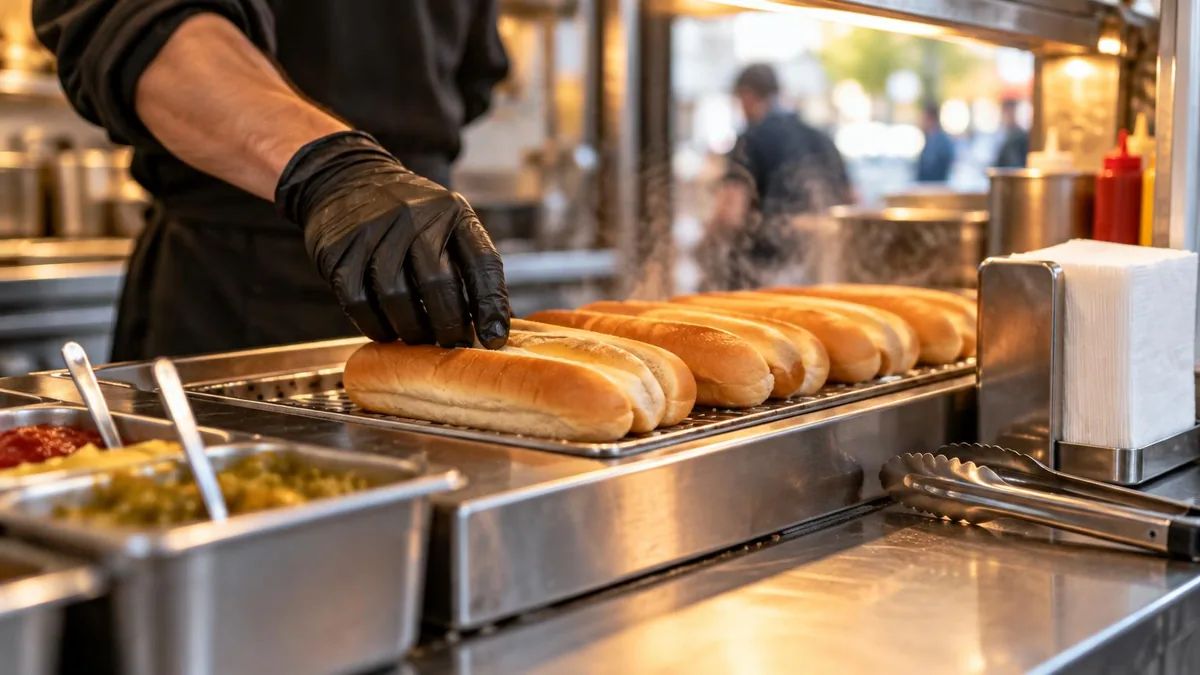
It depends on the result you're after. Steam restores softness and warmth to the crumb and is the typical choice for the classic hot dog bun made with milk bread; if overdone, it makes the bun gummy. The griddle toasts the surfaces, creates a light crust and improves hold with sauces: it's ideal for the split-top bun with flat sides. Many venues use both techniques, depending on the bun on the menu.
Is the oven suitable for reheating hot dog buns?
Yes, especially when many pieces need reheating together, as in catering or events. A combi oven with a steam setting helps limit dehydration. It's worth running a test tray to calibrate the timing on your own oven.
How do I stop the bun from getting soggy with sauces and toppings?
A few tips help: choose a bun with a crumb structure suited to the amount of sauce, lightly toast the inside or the surfaces on the griddle, put runnier sauces on top of the sausage rather than directly on the bun, and assemble as close as possible to the moment of consumption. The order of toppings matters too: drier ingredients can act as a barrier.
Do hot dog buns hold up for delivery?
Delivery is the toughest test, because many minutes pass between preparation and consumption inside a closed container, where steam softens the bun. It's best to choose a bun with good structure, toast it lightly, use containers with vents, and, where possible, serve sauces separately. A full test that simulates the actual delivery time is the most reliable way to decide.
Which bun size should I choose?
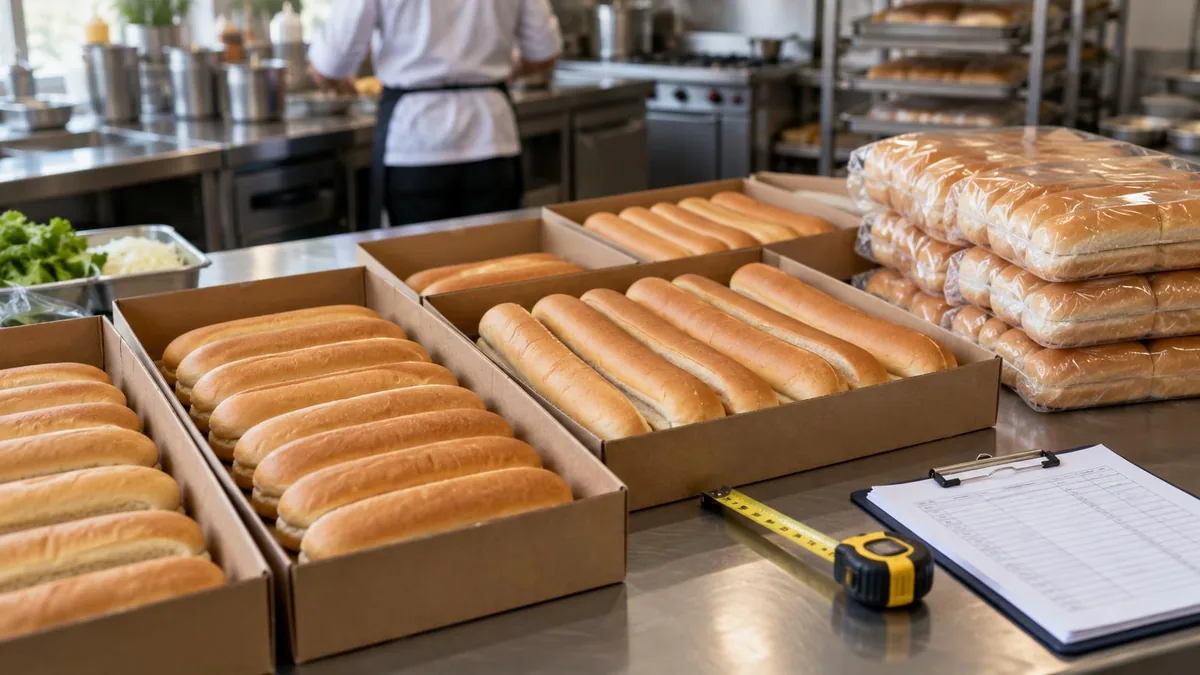
The size follows the sausage: the bun should be as long as the cooked sausage, or slightly shorter, with a cross-section matching its thickness. As a general guide, common standard sizes are often around 15–18 cm, mini sizes for catering under about 12 cm, and long sizes over 19 cm; the actual measurements are those given in the technical data sheet.
Pre-sliced or whole?
Pre-sliced buns save time and guarantee a uniform cut, which is why they're the most widely used option in fast service. Whole buns are preferable when a particular cut is wanted, for example a top-slit cut, or a Nordic-style pull-apart bun, or when you want to protect the crumb for longer.
How do you organise a wholesale purchase?
Start with an estimate of consumption, based on the venue's own history or on similar events, add a safety margin, and round up to the number of pieces per case from your supplier. Minimum order quantities, delivery times, available storage space in the warehouse or freezer, and availability during peak periods should all be clarified in advance.
Can I offer a gluten-free hot dog?
Yes, but the term "gluten-free" is regulated under Regulation (EU) No 828/2014: the product as served must contain no more than 20 mg/kg of gluten. It's not enough to simply buy a bun labelled that way: separate storage, dedicated utensils and surfaces, preferably single-portion packs, and trained staff are all needed. If contamination cannot be ruled out, this must be communicated transparently.
Which allergens do I need to declare for a hot dog?
All those listed in Annex II of Regulation (EU) No 1169/2011 that are present in the dish as served. Hot dogs frequently involve cereals containing gluten, milk, eggs, sesame, soya, mustard and celery, across the bun, the sausage and the sauces. This information is mandatory even for non-prepacked foods and must be provided in the manner set out by national rules, for example on the menu or in a register available on request.
Do I need to state on the menu that the bun is frozen?
In Italian foodservice it is established practice, supported by case law on commercial fraud, to flag products that are frozen or were frozen at origin, usually with an asterisk and a note. This applies to buns too. The exact wording should be agreed with your own consultant.
Is it worth requesting free samples before choosing a bun?
Yes, and it's the most useful step. Samples should be tested under real conditions: the same reheating equipment, the same sausages, the same sauces, the same waiting time before consumption. It's useful to compare several products side by side and repeat the test across multiple deliveries to assess consistency.
How do you choose a hot dog bun supplier?
What matters is product quality in practical tests, consistency of shape, length and weight, the completeness of technical data sheets, clarity on allergens and recipe variations, reliability of deliveries even during peak periods, and the cost per portion served, including waste and unsold stock. If external input is needed to set up the comparison, you can ask for a consultation.