Artisan or industrial hot dog buns: how to choose for your venue
Ingredients, proofing, labelling and format consistency: what sets artisan hot dog buns apart from industrial ones, and how to assess a supplier.
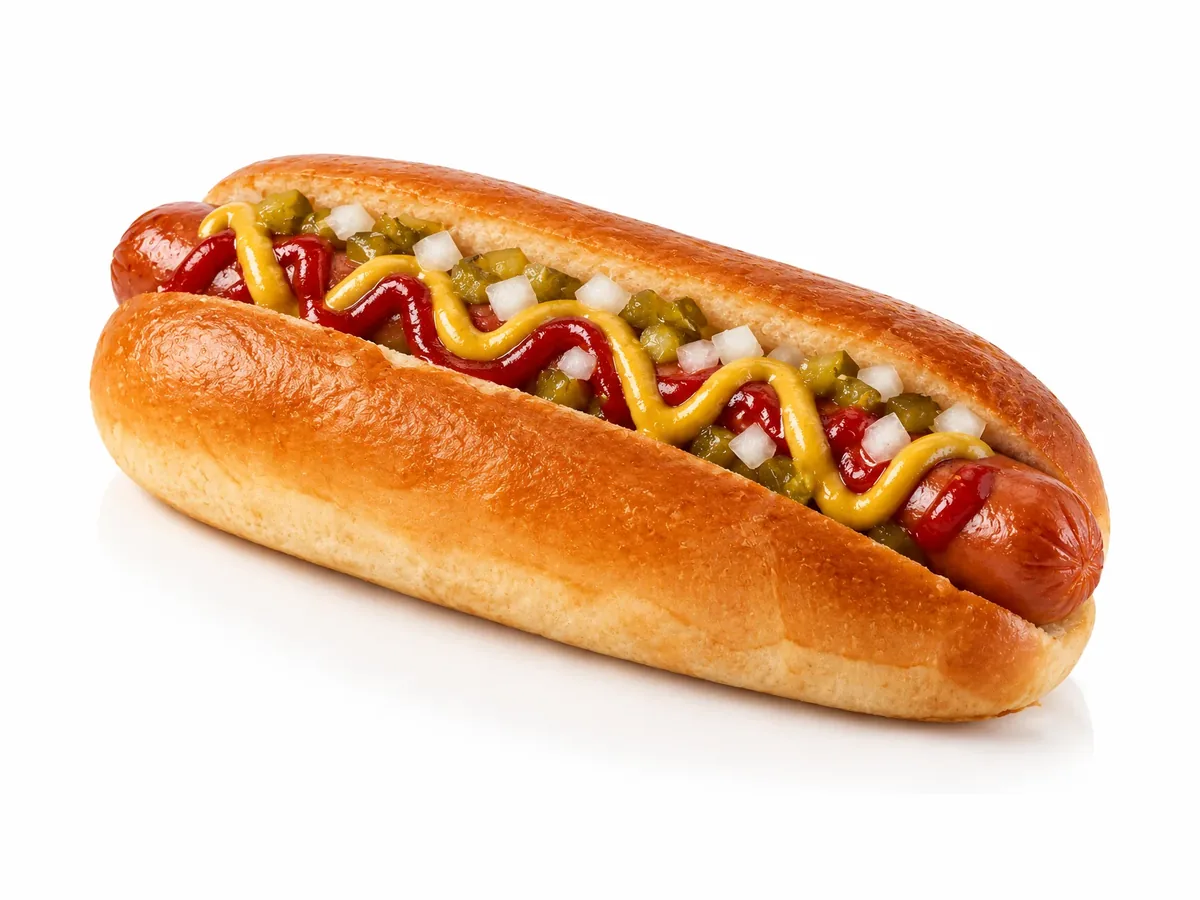
When choosing hot dog buns, the question "artisan or industrial?" comes up early. It's often framed as if there were one universally correct answer, but in day-to-day foodservice the two routes meet different needs. A pub with twenty covers, a food truck working festivals, and a catering operation serving hundreds of people in an hour all have different priorities. This article compares the two approaches on the points that matter for anyone serving hot dogs: ingredients, proofing, labelling, product consistency and supplier reliability.
What "artisan" and "industrial" actually mean
The two terms are used quite loosely. Generally, artisan bread refers to production in small batches, with a significant share of manual work and timings set by the baker; industrial bread refers to continuous-line production, highly automated, with standardised parameters and high volumes. There's also a wide middle ground: medium-sized bakeries producing semi-automatically, with carefully developed recipes and volumes suited to organised foodservice operations.
For this reason, it's more useful to focus less on the "artisan" label and more on the concrete characteristics of the product: what's in the dough, how it's proofed, how consistent it is, and how it arrives in the kitchen.
Ingredients
A hot dog bun is typically made from wheat flour, water, yeast, salt, a share of sugars and fats, often milk or milk derivatives; brioche-style versions add eggs and butter. The differences between products come down to:
- type and quality of flours;
- nature of the fats used (butter, vegetable oils, other fats);
- presence of additives, such as emulsifiers, preservatives or acidity regulators, mainly used to extend softness and shelf life;
- any seeds or toppings (sesame, poppy seeds, coarse salt).
It isn't accurate to say a bun with fewer ingredients is automatically "better": it depends on the use case. An additive that keeps the crumb soft for several days can be useful for operators with lower footfall who want to avoid waste. What matters is knowing exactly what you're buying and being able to communicate it correctly to customers, particularly regarding allergens.
Proofing
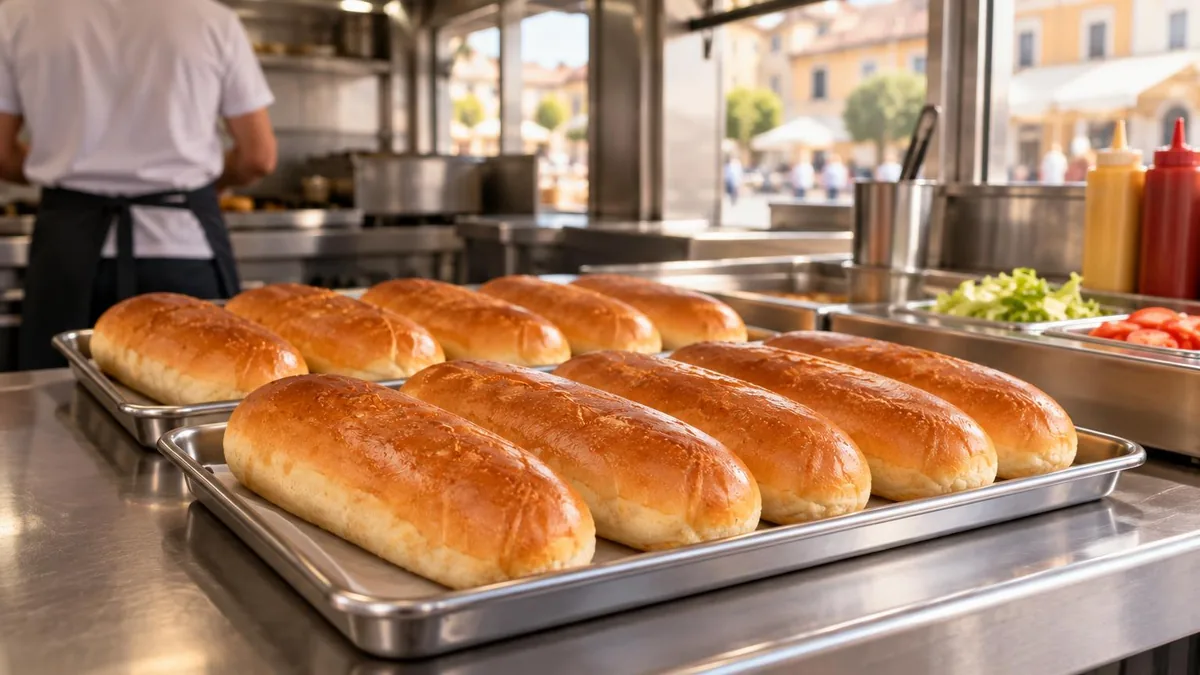
Proofing affects structure, flavour and how the bun behaves when reheated. Artisan production more often uses longer proofing times or pre-ferments, which can give a more flavourful crumb and a less uniform structure. Industrial lines generally work with shorter, more controlled timings, achieving regular crumb structure and consistent softness.
For hot dogs, neither approach is universally superior. A crumb that's too open can let sauce drip through; a crumb that's too dense and light risks turning soggy. A practical test, using your own sauces and service timings, is worth more than any description.
Labelling and information
Pre-packaged bread must carry the information required under Regulation (EU) 1169/2011: name, list of ingredients, allergens highlighted, net quantity, minimum durability date or use-by date, storage conditions, and the responsible food business operator. Bread supplied loose to foodservice operators must still be accompanied by the necessary information, particularly on allergens.
For the restaurant operator, the label or the technical data sheet is a working tool: it's used to complete the allergen register, answer customer questions and plan stock. A supplier, whether artisan or industrial, that fails to provide a clear, up-to-date technical data sheet creates an operational problem, regardless of the quality of the bread itself.
Consistency of shape and length
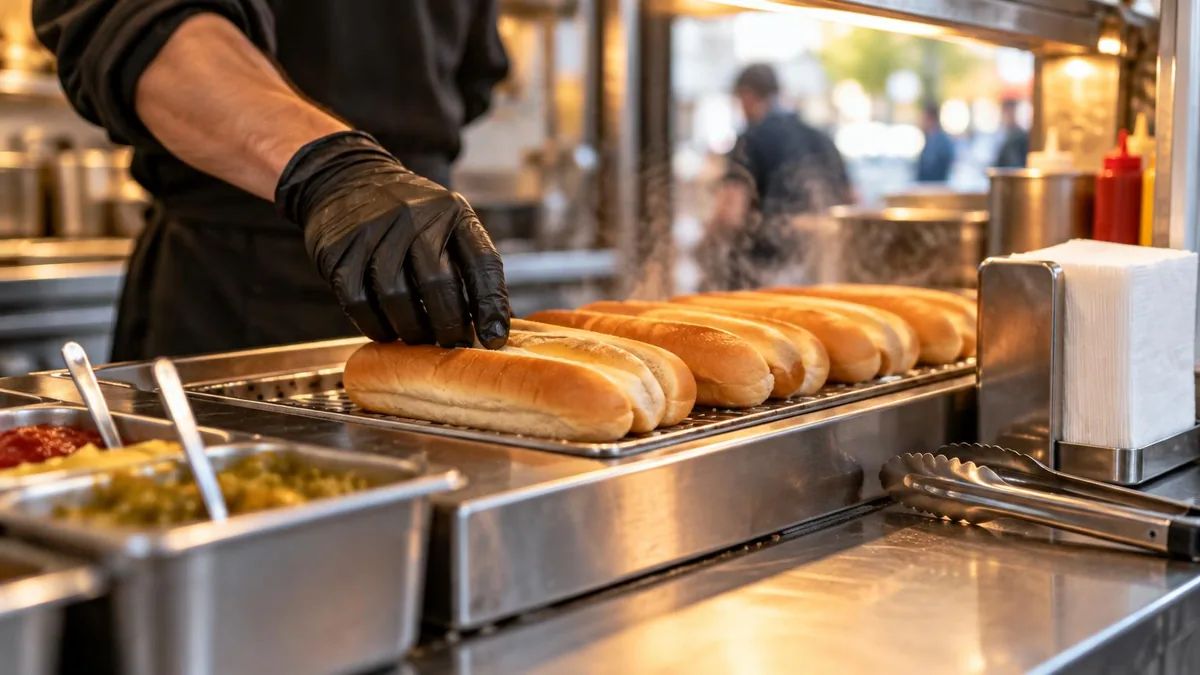
This is arguably where the difference is felt most in fast service. When preparing dozens of hot dogs an hour, it matters that:
- all buns have the same length, matching the sausages used;
- the cut is even and at the same depth;
- the crust colour is uniform, so reheating gives the same result every time;
- the weight is stable, to keep food cost under control.
Industrial production generally guarantees very high consistency. Artisan bread can show small variations from one piece to the next, which go unnoticed in a venue with table service but which slow things down and make yield less predictable on a stadium-style assembly line. Many well-organised artisan bakeries work with moulds and portioning equipment and achieve good regularity: this needs to be checked case by case.
Availability, logistics and storage
Other practical points to weigh up:
- Delivery frequency: fresh artisan bread requires more frequent deliveries; industrial bread, often packaged or frozen, can be managed with less frequent orders.
- Capacity at peak times: for events or peak seasons, the supplier needs to be able to scale volumes up without changing the product.
- Storage: fresh bread, long-life packaged bread, blast-chilled bread and frozen bread all require very different handling. Shelf life depends on each producer's recipe and process: the technical data sheet is the reference point.
- Formats: a flexible producer may be able to make custom lengths or finishes to order; an industrial line typically offers a fixed range, with higher minimum order quantities for customisation.
How to assess a supplier
Whether you're dealing with a local bakery or a large producer, a few checks help you decide with confidence:
- Ask for the technical data sheet for every product: ingredients, allergens, weight, dimensions, storage, shelf life.
- Request free samples and test them under real service conditions: the same griddle or steamer, the same sauces, the same waiting times.
- Check consistency across several deliveries, not just the first sample.
- Clarify lead times and minimum order quantities, especially for events and peak periods.
- Ask how recipe changes are communicated, since these can affect the allergen picture.
- Assess the cost per portion served, factoring in waste and returns, not just the unit price.
Operators who don't have time to run this comparison can seek advice, but the criteria remain the same.
A choice that can be mixed
It's not unusual for a venue to combine both solutions: a highly consistent industrial bun for the core menu and peak periods, and an artisan bun for one or two special menu items. What matters is that each choice fits the pace of service and that ingredient information is always available.
Frequently asked questions
Is artisan bread always higher quality?
Not necessarily. "Artisan" describes a way of producing, not a guarantee of a better result for hot dogs on its own. It's worth assessing ingredients, performance with sauces, consistency and delivery reliability through practical testing.
Why is industrial bread often preferred in fast service?
Because it typically offers very consistent shape, length, weight and cut, making assembly times and yield predictable. Some well-equipped artisan bakeries also achieve good regularity: this should be checked against real deliveries.
What documents should you request from a hot dog bun supplier?
At minimum, the technical data sheet for each product, covering ingredients, allergens, weight, dimensions, storage method and shelf life. It's also useful to know how the supplier communicates any recipe changes.